Concrete to Canvas: How Mid-Sized American Cities Are Reinventing Neglected Plazas Through Global Creative Alliances
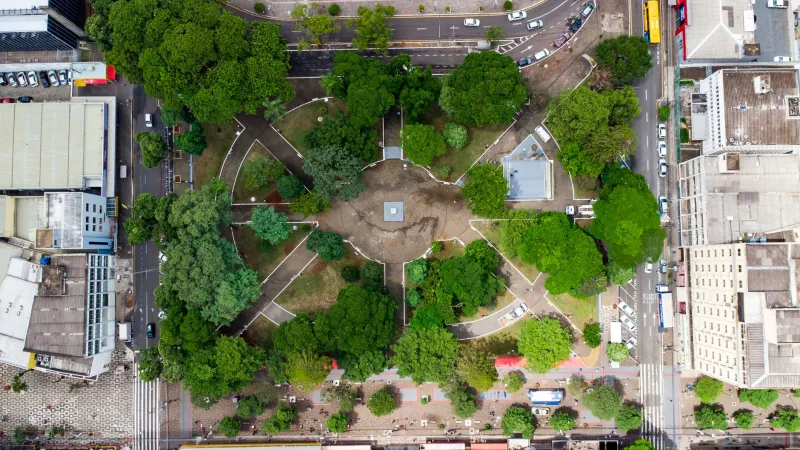
For decades, the fate of many American public plazas followed a familiar and disheartening arc. Designed with civic ambition during mid-century urban booms, these spaces gradually surrendered their vitality to shifting demographics, disinvestment, and the quiet erosion of foot traffic. The result was a landscape of underutilized concrete, broken fountains, and faded municipal signage — places that people passed through rather than gathered within.
The post-pandemic era, however, has introduced a striking counternarrative. Across cities from Akron to Albuquerque, civic leaders and arts administrators are discovering that international creative partnerships offer something domestic urban planning often cannot: a genuinely fresh perspective, untethered from local convention and institutional inertia. The results are reshaping not only the visual character of these spaces but also the communities that surround them.
Why Mid-Sized Cities Are Leading the Charge
It would be reasonable to assume that the most ambitious public art transformations unfold in cultural capitals — New York, Los Angeles, Chicago. And yet it is precisely in mid-sized American cities where the most compelling experiments in international creative collaboration are currently taking root.
The reasons are both practical and philosophical. Smaller cities tend to offer artists greater latitude for risk-taking. Municipal bureaucracies, while never entirely absent, are frequently more navigable. Available real estate — in the form of neglected plazas, dormant lots, and underused civic corridors — is abundant. And perhaps most significantly, the hunger for cultural reinvention is acute. Cities that once anchored regional economies through manufacturing or resource extraction have spent years searching for a new identity, and public art has emerged as a surprisingly effective vehicle for that search.
Civic arts programs in cities like Chattanooga, Tennessee, and Tulsa, Oklahoma, have been particularly deliberate in seeking international voices. Rather than commissioning work that reflects existing local aesthetics, these programs have extended invitations to artists from West Africa, Southeast Asia, and South America — practitioners whose visual languages carry entirely different assumptions about public space, community gathering, and the relationship between art and civic life.
The Architecture of a Successful Partnership
What distinguishes a genuinely transformative international art collaboration from a well-intentioned but superficial cultural import? The most successful projects share several structural qualities that are worth examining closely.
First, meaningful community engagement precedes the arrival of any artist. The most celebrated recent examples — among them a large-scale mosaic installation in a revitalized downtown plaza in Greensboro, North Carolina, created in partnership with a Portuguese tile collective — began with months of neighborhood listening sessions. Residents were not merely consulted; they were treated as co-authors of the project's conceptual framework. The international artists, in turn, arrived not with finished ideas but with open questions.
Second, these partnerships tend to involve sustained residencies rather than remote commissions. When an artist from Lagos or Medellín spends three to six months embedded in an American city, the resulting work carries a specificity that a commissioned design — however technically accomplished — simply cannot replicate. The textures of local life, the particular quality of afternoon light in a Midwestern plaza, the sounds of a specific neighborhood: these elements find their way into the work precisely because the artist was present to absorb them.
Third, successful collaborations are almost always institutional in structure, involving not just a single commissioning body but a constellation of partners — arts councils, municipal governments, local businesses, universities, and community organizations. This distributed ownership model ensures that the work is sustained and celebrated long after the installation is complete.
Economic and Social Ripple Effects
The case for international public art partnerships is not purely aesthetic. The economic evidence, while still accumulating, is increasingly persuasive.
Studies of arts-led urban revitalization consistently demonstrate that high-quality public installations generate measurable increases in foot traffic, retail activity, and property values within their immediate vicinity. The mechanisms are straightforward: distinctive public spaces attract visitors, visitors support local businesses, and visible investment signals to potential residents and developers that a neighborhood is in ascent.
The social dimensions are equally significant, if harder to quantify. Public art created through genuine cross-cultural dialogue has a demonstrated capacity to alter the social atmosphere of a space — to make it feel genuinely welcoming to a broader range of people. In cities with complex histories of racial and economic segregation, this is not a trivial achievement. When a plaza that was once avoided by large segments of the population becomes a site of shared pride, the implications extend well beyond the visual.
In Raleigh, North Carolina, a recently completed collaborative installation involving artists from Brazil and Japan — organized in part through an international creative network — has become one of the most photographed public spaces in the city. More importantly, it has become a gathering point for communities that had little previous reason to occupy the same civic space. Local arts administrators describe a qualitative shift in how the plaza functions: less transit corridor, more living room.
The Challenges That Remain
It would be misleading to present this movement as without friction. International creative partnerships introduce genuine logistical and conceptual challenges that cities must navigate with care.
Visa and immigration constraints can complicate or delay residencies, particularly for artists from regions with complex entry requirements. Funding structures for public art in the United States remain fragmented and often inadequate, placing an outsized burden on individual cities and arts organizations to assemble support from multiple sources. And the risk of superficiality — of international art deployed as cultural decoration rather than genuine community engagement — is ever-present. Critics within urban planning and arts communities have raised legitimate concerns about projects that prioritize spectacle over substance, or that bring international voices into communities without adequately amplifying the voices already present.
These tensions are worth taking seriously. The most thoughtful practitioners in this space acknowledge them openly and build mechanisms for accountability into their project structures from the outset.
A New Grammar for Civic Space
What the most ambitious international public art partnerships ultimately offer is something that urban planning alone has rarely been able to provide: a new grammar for thinking about what civic space is for. Not merely transit, not merely commerce, not merely the backdrop to daily routine — but a site of genuine encounter, where the unexpected can occur and where a community's sense of itself can be productively complicated and enriched.
The cities that are embracing this possibility most fully are discovering that the investment — in time, in resources, in the willingness to cede some creative control to perspectives formed elsewhere in the world — returns something of considerable and lasting value. The plazas being transformed through these collaborations are not simply more beautiful than they were. They are more alive.
For a country still reckoning with the social and spatial legacies of the pandemic years, that distinction matters enormously. The concrete is being reimagined. The canvas, it turns out, was always there.