Seventy-Two Hours to Genius: Inside the Global Art Sprints Transforming American Creative Culture
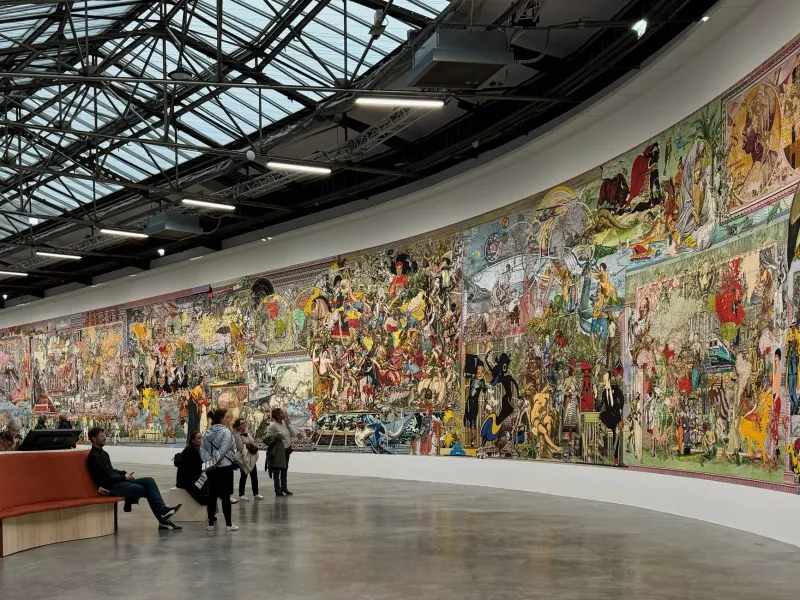
The alarm goes off at 6:00 a.m. on a Friday in Detroit. By Sunday evening, a temporary installation measuring forty feet across must be complete, documented, and ready for public presentation. Between those two points lies seventy-two hours of creative pressure that most artists describe as simultaneously the most terrifying and most productive experience of their professional lives.
This is the world of the international art sprint—a format that has quietly become one of the most consequential proving grounds in contemporary global creativity. And increasingly, American cities are becoming its most ambitious hosts.
The Format That Changes Everything
The mechanics of a typical 72-hour art competition are deceptively simple. Teams of two to five artists—assembled from across different countries, disciplines, and creative traditions—are given a site, a theme, and a deadline. They receive a modest materials budget, access to shared tools and workspace, and the company of a dozen or more equally pressured teams working in parallel. Everything else is up to them.
What makes the format so generative is precisely what makes it so uncomfortable. There is no time for the kind of extended deliberation that typically governs large-scale creative projects. There is no opportunity to retreat to familiar methods or to wait for inspiration to arrive on its own schedule. Artists must make decisions quickly, trust their collaborators instinctively, and commit to approaches that might feel unresolved. The pressure, counterintuitively, tends to produce work of unusual originality.
Organizers of these events consistently report that the pieces created under sprint conditions differ markedly from what the same artists produce in conventional studio contexts. There is a rawness, an urgency, and a willingness to take formal risks that more leisurely timelines tend to sand away.
American Cities as Competitive Arenas
Detroit, Pittsburgh, New Orleans, and Tucson have each hosted significant international art sprint events in recent years, and the model is spreading to smaller markets. What draws these cities to the format is not merely the spectacle of watching artists work under pressure—though that draws considerable public interest—but the lasting infrastructure the events leave behind.
Pittsburgh's iteration, organized through a partnership between a local arts foundation and a Berlin-based curatorial collective, brought together eighteen artists from eleven countries over a single weekend in a decommissioned rail yard. The event generated four permanent public installations, three ongoing international collaborative relationships, and a documentary that has since screened at festivals on three continents. The city's investment—approximately $200,000 in total, including artist fees, materials, and event production—yielded a creative legacy that local arts administrators estimate would have cost several times that amount through conventional commissioning processes.
New Orleans presents a particularly compelling case study. The city's deep tradition of improvisational creative culture has made it a natural fit for the sprint format. Its most recent international competition drew participants from Brazil, South Korea, Senegal, and Poland, among others. Local artists were embedded within each international team, a structural decision that proved transformative. The resulting works drew explicitly on New Orleans's architectural and cultural vocabulary while incorporating visual languages that the city's creative community had never previously encountered in such immediate proximity.
Discovery at Speed
Perhaps the most significant function of the sprint format is its role as a talent discovery mechanism. Traditional pathways for identifying emerging international artists—residency applications, gallery submissions, biennial nominations—are slow, resource-intensive, and often biased toward artists who already have institutional relationships. The sprint format bypasses much of that gatekeeping infrastructure.
Curators, gallery directors, and public art commissioners who attend these events as observers have described them as the most efficient talent scouting environments they have encountered. Within a single weekend, they can observe dozens of artists working under conditions that reveal not just technical skill but creative problem-solving, collaborative temperament, and the capacity to perform under pressure—qualities that no portfolio review can adequately assess.
Several artists who have participated in US-hosted sprint competitions have subsequently received gallery representation, public art commissions, and residency invitations that they attribute directly to visibility gained during those seventy-two hours. For artists from countries with limited access to American art market networks, the sprint format represents a genuinely democratizing entry point.
The Collaboration Chemistry
Organizers who have run multiple sprint events are increasingly sophisticated about team composition. Early iterations often assigned teams randomly or by discipline. Current practice tends toward intentional pairing of artists whose backgrounds are complementary rather than similar—a sculptor with a textile artist, a muralist with a sound designer, a ceramicist with a digital fabricator.
The results of these deliberately mismatched teams have been consistently more interesting than those of more homogeneous groups. When artists cannot default to shared methodologies, they are forced to negotiate a new creative language in real time. The process of that negotiation—often conducted across actual language barriers as well as disciplinary ones—tends to produce work that neither artist could have conceived independently.
One Detroit-based organizer described the dynamic succinctly: the teams that struggled most in the first twelve hours typically produced the strongest work by hour seventy-two. The initial friction was not a problem to be managed but a resource to be channeled.
Networks That Outlast the Weekend
The professional relationships forged during sprint competitions have proven remarkably durable. Artists who meet under the intensity of a shared deadline report forming bonds that persist long after the event concludes. Several ongoing international collaborative projects—including a traveling installation that has appeared in Chicago, Oslo, and Cape Town—trace their origins directly to partnerships formed during sprint competitions.
For American artists, participation in these events offers something that conventional professional development rarely provides: genuine peer relationships with international counterparts built on demonstrated creative compatibility rather than institutional introductions. In an art world still substantially organized around geographic proximity and institutional affiliation, that kind of connection carries considerable value.
The sprint format is not without its critics. Some argue that the pressure-cooker environment privileges certain personality types over others, disadvantaging artists whose processes require extended reflection. Others note that the logistical demands of international travel create access barriers for artists from lower-income countries. These are legitimate concerns that the most thoughtful organizers are actively working to address through stipend structures, remote participation options, and more deliberate geographic outreach.
But for the cities hosting these events, the format has demonstrated something important: creativity does not require unlimited time. Sometimes, it requires exactly the opposite.